 Skip to content
The 7 Most Crucial Factors for Savoring Bhitarkanika National Park
These are the 7 most crucial factors for savoring Bhitarkanika National Park :
I. Bhitarkanika National Park Overview
After the Sunderbans, Bhitarkanika National Park, which is in Odisha’s Kendrapara district, is arguably the country’s largest mangrove forest. As one of India’s designated RAMSAR sites, Bhitarkanika is a wetlands of global significance.
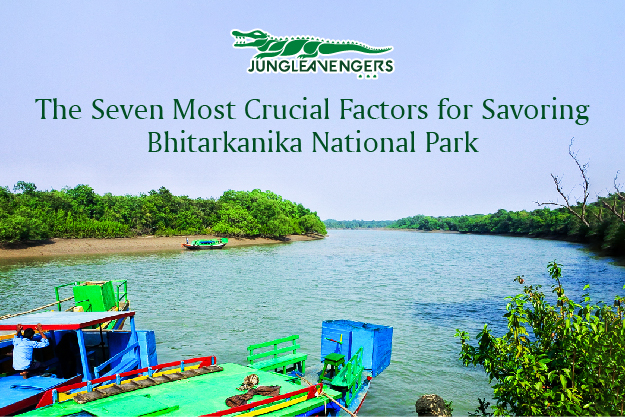
The largest Crocodile Sanctuary in India, Bhitarkanika is flooded by the Brahmani and Baitarani river systems and their numerous tributaries. The river rivers of Bhitarkanika are home to almost 1800 saltwater crocodiles.
While on a boat safari through the river channels, tourists will undoubtedly hear the constant chirping of birds. In addition to the many native birds that call Bhitarkanika home, a large number of migratory birds also visit during the monsoon season and remain until the end of October. All of these factors work together to create a rich natural environment that visitors will enjoy seeing up close.
While on a boat safari via the river channels, tourists will undoubtedly hear the constant chirping of birds. In addition to the many native birds that call Bhitarkanika home, a large number of migrants also visit during the monsoon season and remain until the end of October. All of these factors work together to create a rich natural environment that visitors will enjoy seeing up close. Crocodiles, which can reach lengths of over 20 feet, can be seen lounging in the sun on shores of the rivers.
II. Bhitarkanika National Park Entrance
Khola is the main gate leading to Bhitarkanika. Another gate is known as the Gupti gate. If you are considering a journey to Habalikuti, an island that can only be reached by boat in a little over two and a half hours, this will be more helpful.
III. Bhitarkanika National Park Bird Watching
The primary pastime of Bhitarkanika is bird watching, which also includes seeing basking crocodiles. An ideal destination for nature photographers. Tourists should be aware, nevertheless, that migrating birds leave the Sanctuary at the end of October. Accordingly, August 1 through late October are the best times of year to go bird watching at Bhitarkanika.
Among native birds, kingfishers are the major attraction. There’s a chance you could encounter four or six different kinds on any trip.
IV. Bhitarkanika National Park’s animal sightseeing
The best time to visit Bhitarkanika is between October and February if you want to see crocodiles and other animals. Visitors should be aware that boats are the only way to see the area. Please remember that the national park is only accessible by licensed boats. There are fewer boasts, and the demand for safari boats rises dramatically on weekends and holidays. These days, boats often charge arbitrary prices. Therefore, it is preferable to ask the hotel or resort where you are staying to reserve a boat for yourself.
The following animals can be seen on the paths, which are open to tourists: spotted deer, hyenas, fish cats, giraffes, wild boar, monitor lizards, pythons, and snakes such as king cobras, cobras, kraits, and other water snakes.
V. Bhitarkanika National Park lodgings
The ideal place to stay in Bhitarkanika, which is situated at Nalitapatia Jetty, right on the banks of the River Brahmani. When reservations are made in advance, day visitors are also welcome for lunch. With 11 cottages spread across 4 acres, this is arguably the only resort in the genuine meaning of the word. Another option to stay is Jungle Resort, a so-called resort that is less than an acre in size and offers tent accommodations. Additionally, OTDC opened a ten-room hotel in Dangamal. The Forest Department now has ten rooms as well. In the nearby villages, a few new homestays were also established and there is growing support for them.
VI. Items to Bring
Remember to bring plenty of water when you venture into the wilderness. Many travel bloggers advise bringing insect repellent lotions, but only people who have never been to Bhitarkanika or who do it merely because it’s customary do so. Mosquito repellents are not necessary. Because it can get a little cold and the breeze could be greater in the morning and evening during the winter, you might feel the need to wear a light jacket.
VII. Bhitarkanika National Park Access
From Bhubaneswar, it takes three to five hours to get to Bhitarkanika National Park. This is the highway that connects Chennai and Kolkata. It travels via Cuttack and Chandikhol before turning left onto the Paradeep highway, which leads to Kendrapara.
After passing through Cuttack, one can alternatively take the state route, which eventually leads to Kendrapara via Jagatpur and Salipur. The path is the same as described above from there. The Bhitarkanika is approximately 155 kilometers from Bhubaneswar via this route. The journey is 25 kilometers shorter from Cuttack than it is from Bhubaneswar. The rest of the journey is identical.
It takes about eight to nine hours to get to Bhitarkanika from Kolkata. Bhitarkanika can be reached in just under eight hours from Jamshedpur.
Also read : Top 10 Resort in Bhitarkanika National Park , What is the cost of Bhitarkanika tour package? , Best Activities to Do in Bhitarkanika National Park , Top Reasons to Choose Jungle Avengers – A Nature Resort in Bhitarkanika