
A mangrove forest in India is a community of salt-tolerant trees forming a thicket that grows in the interface between land and sea, predominantly along the tidal coasts, estuaries, river deltas, and sheltered coastlines. These forests shield India’s coasts from cyclones, underpin fisheries, harbor vast amounts of carbon, and support millions of people who live along the coast.
If you want to know where the largest mangrove forests in India are, what is their size, and which are the major hotspot areas, this guide will provide you with clear answers among others—minus the jargon.
Where Is Mangrove Forest Mainly Found in India?
Mangroves in India are concentrated along three coastal settings:
- River deltas on the east coast (freshwater + silt = ideal growth)
- Arid and semi-arid creeks on the west coast
- Island ecosystems in the Bay of Bengal and Arabian Sea
From the fieldwork and conservation projects I’ve been involved in, mangroves do best where tidal flow is not impeded and where freshwater flow hasn’t been cut off by dams or levees.
Major regions at a glance
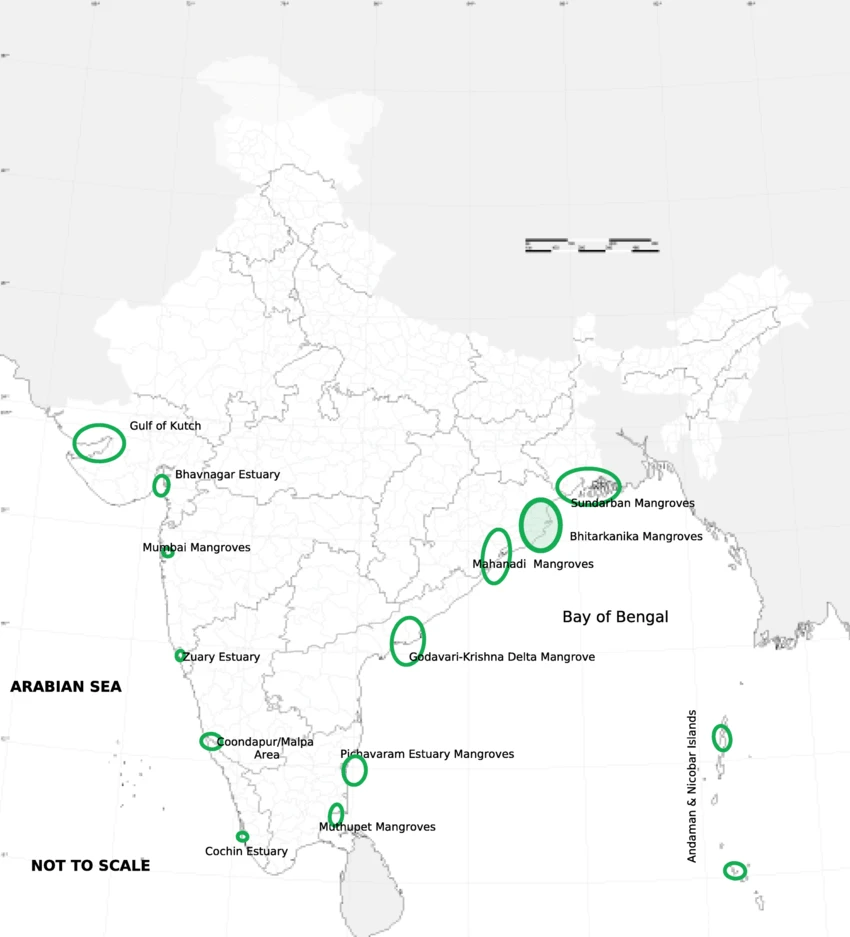
- East Coast (largest share): West Bengal, Odisha, Andhra Pradesh, Tamil Nadu
- West Coast: Gujarat, Maharashtra, Goa, Karnataka, Kerala
- Islands: Andaman & Nicobar Islands, Lakshadweep (limited patches)
Biggest Mangrove Forest in India (and Why It’s Unique)
The largest mangrove forest of India and the world is Sundarbans.
Why the Sundarbans stands apart:
- Spreads across India and Bangladesh
- Interlaced with hundreds of tidal rivers and creeks
- Home to rare species like the Royal Bengal Tiger
- Acts as a natural cyclone shield for Kolkata and nearby districts
Real-world insight:
Post-Cyclone Amphan, villages protected by undisturbed mangrove belts experienced far less damage compared to those where mangroves had been cut. This isn’t theory—it’s visible on the ground.
List of Mangrove Forest in India (Major Ones Only)
| Region | Important Mangrove Areas |
| West Bengal | Sundarbans |
| Odisha | Bhitarkanika |
| Andhra Pradesh | Godavari Mangroves, Krishna Mangroves |
| Tamil Nadu | Pichavaram, Muthupet |
| Gujarat | Gulf of Kutch |
| Maharashtra | Mumbai Creek, Thane Creek |
| Andaman & Nicobar | North Andaman mangroves |
Why Mangrove Forests Are Critical for India (Beyond Textbook Reasons)
People often say mangroves are “important,” but here’s how they matter in real life:
1. They Reduce Cyclone Damage
In the villages I’ve seen all along the coast of Odisha, houses situated behind mangrove belts were subjected to less wind and storm surge during cyclones.
2. They Support Fisheries
Mangroves serve as nurseries for prawns, crabs and fish. As for the disappearance of mangroves, fishermen don’t whine about “climate change” – they whine about having nothing to catch.
3. They Store Carbon (Quietly)
Mangroves store carbon in their muddy soils for centuries, which makes them even more efficient than many land-based forests.
Common Mistakes People Make About Mangrove Forests in India
From awareness campaigns and field interactions, these misunderstandings come up repeatedly:
- “Mangroves only grow in seawater”
→ They need brackish water, not pure seawater. - “Planting mangroves anywhere works”
→ Wrong. Without correct tidal flow, plantations fail silently after a few years. - “Concrete embankments are better than mangroves”
→ Embankments crack. Mangroves regrow and self-repair.
Practical Example: What Happens When Mangroves Are Removed?
In parts of the east coast, mangroves were cleared for shrimp farming. Short-term profits looked good. Within years:
- Soil turned saline
- Farms collapsed
- Coastal erosion increased
Restoration projects now cost more than what was earned initially. This pattern repeats across states.
Current Threats to Mangrove Forests in India
Despite protection laws, mangroves still face pressure from:
- Coastal real estate development
- Port expansion
- Aquaculture without zoning
- Upstream dams reducing freshwater flow
From my experience, the biggest silent killer isn’t logging—it’s blocked tidal movement caused by poorly planned infrastructure.
What Actually Works for Mangrove Conservation (On Ground)
Effective conservation isn’t about slogans. It’s about:
- Restoring natural tidal creeks
- Involving local fishing communities
- Allowing mangroves to regenerate naturally instead of forced planting
States that followed this approach—like parts of Odisha and Gujarat—are seeing measurable recovery.
Final Thoughts
Understanding the mangrove forest in India is not only about knowing names or maps. It’s about understanding how these systems silently guard coastlines and the lives and diversity they sustain – frequently with little acknowledgment.
If India manages mangrove conservation well, it will be like having a natural protective shield that no concrete structure could replace.
Frequently Asked Questions (FAQs)
1. Where are mangrove forests located in India?
The mangroves of India are located along river deltas, tidal creeks, and coastal estuaries at the confluence of freshwater and seawater. Mostly they are found on east coast and some parts of the west coast Andaman & Nicobar Islands.
2. Which is the biggest mangrove forest in India?
The Sundarbans is the largest mangrove forest of India and the world that lies in the border of West Bengal and Bangladesh.
3. Can we swim in mangrove forests?
No, swimming in mangrove forests is dangerous because of the powerful tidal currents, the underwater roots, the muddy bottoms and even the wildlife – including crocodiles and snakes.
4. Where is India’s first mangrove area?
The first scientifically recorded mangrove region in India is the Sundarbans, West Bengal.
5. What is special about mangroves?
Mangroves can grow in saline, low-oxygen soil, shield coastlines from cyclones and erosion, serve as nurseries for marine life and hold vast amounts of carbon.
6. Are there tours of mangrove forests in India?
Yes, guided eco-tours are conducted in certain areas such as Sundarbans, Pichavaram (Tamil Nadu) and Bhitarkanika (Odisha).
Also read : best-hotels-in-bhitarkanika , What is the cost of Bhitarkanika tour package? , Best Activities to Do in Bhitarkanika National Park , Top Reasons to Choose Jungle Avengers – A Nature Resort in Bhitarkanika, rooms-in-bhitarkanika
Tagged bhitarkanika national park, jungle avengers, jungle avengers resort, odisha, Pentha Sea Beach, resort in bhitarkanika, resort in bhubaneswar, Travel